
Quick Verdict & Buyer Stop-Loss Card
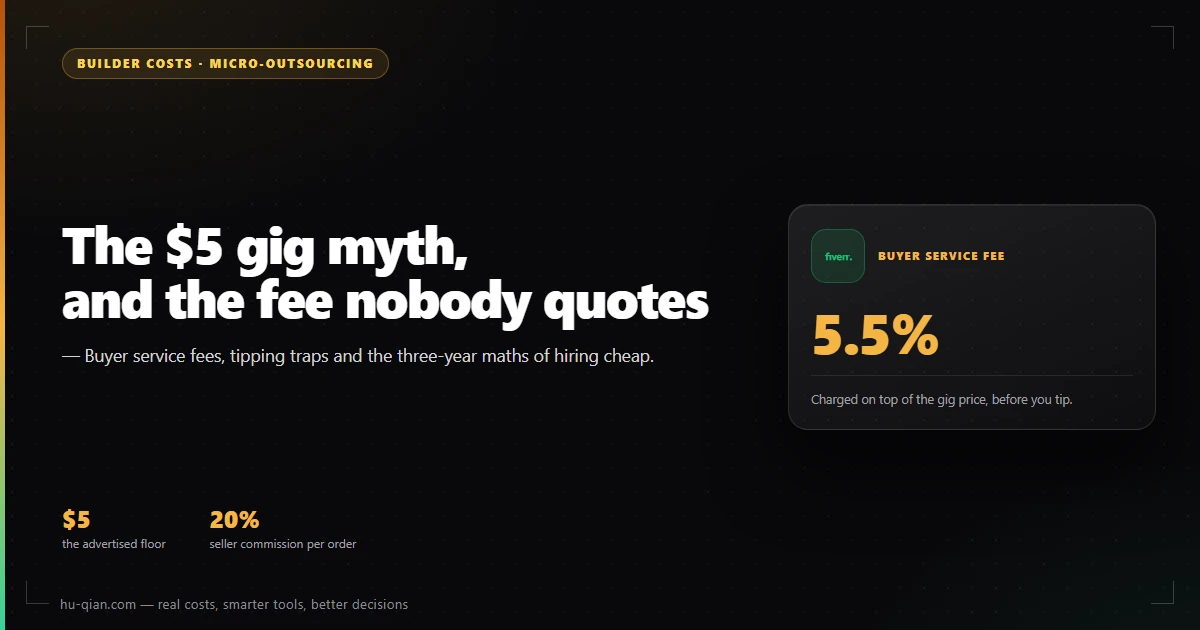
Fiverr charges a 20% seller commission, a 5.5% buyer service fee, and a $2.50–$3.50 small-order charge — so a “$5” gig costs the buyer roughly $8 while the seller nets $4. Cheap for defined, one-off deliverables; quietly expensive as a standing agency, because a freelancer relationship has no volume discount and no economy of scale. Stop-loss: if your brief takes more than 15 minutes to write, the task is too vague to outsource; if a seller asks you to pay off-platform, walk away.
Use it when: the scope fits in a brief under 15 minutes, the deliverable is checkable (code, a file, a page), and you need it once. Skip it when: you need the same thing every week (that is a retainer or a subscription), or the task cannot be described precisely enough to verify.
Buyer stop-loss rules:
- If your brief takes more than 15 minutes to write, the task is too vague to outsource. That is a signal to narrow scope first, not to hire and hope.
- If a seller asks you to pay off-platform, stop immediately. Off-platform payment removes Fiverr’s dispute protection — you lose the only leverage you have.
- If a $5 gig is the plan, do the fee math first (below). It is rarely $5, and the $5 tier is where low-quality, templated work concentrates.
The headline number is not the cost. The headline number is the bait.
The True Fiverr Expense Ledger
Fiverr charges two separate fees on the same transaction — one to the seller, one to the buyer — plus a small-order surcharge. Here is the full picture.
| Fee | Who pays | Rate | Notes |
|---|---|---|---|
| Seller commission | Seller | 20% of the order | Seller keeps 80%. Flat — no volume tiers, no loyalty discount |
| Buyer service fee | Buyer | 5.5% of the purchase | Added at checkout on top of the gig price |
| Small-order fee | Buyer | Conflict — see below | Regressive: hardest on small orders |
| Fees on extras & tips | Both | Charged per transaction | Extras and tips are billed as separate payments |
The small-order fee has a documented conflict. Fiverr’s own seller FAQ states an additional $2.50 is applied to purchases under $75. Widely cited third-party breakdowns state $3.50 is applied to orders under $200. Both cannot be right, and I am not going to pretend otherwise — treat the exact threshold as unconfirmed and check your own checkout before ordering. The direction is unambiguous: small orders carry a disproportionate flat fee.
Worked example — the $5 gig, honestly priced:
| Line | Amount |
|---|---|
| Listed gig price | $5.00 |
| Buyer service fee (5.5%) | +$0.28 |
| Small-order fee (unconfirmed: $2.50–$3.50) | +$2.50 – $3.50 |
| Buyer actually pays | $7.78 – $8.78 |
| Seller nets (after 20% commission) | $4.00 |
| Platform keeps | $3.78 – $4.78 (≈ 49–54% of the buyer’s payment) |
A “$5” order can cost the buyer ~$8 and leave the seller $4, with the platform capturing roughly half of what changes hands. On a $25 order the fee load is smaller in percentage terms but still real: 5.5% ($1.38) + the flat small-order fee pushes the buyer to roughly $28.88–$29.88, while the seller nets $20.00.
The 3-year math of micro-outsourcing. Suppose you hire two $25 gigs a month instead of stacking more subscriptions:
| Approach | Monthly | 3-year total |
|---|---|---|
| Two $25 gigs/month | $50 | ~$1,800 |
| One $99/mo SaaS subscription | $99 | ~$3,564 |
These are modeled figures — arithmetic on list prices, not what any customer paid. They assume a steady cadence; real usage fluctuates.
The takeaway is not “gigs are always cheaper.” It is that a recurring problem with a $99/mo software answer and a $25 one-off outsourcing answer are not the same purchase — and solo founders routinely pay the subscription for a task they touch twice a month.

The 4 Hiring Traps on Fiverr
Trap 1: The $5 gig mirage and its review farm
The $5 tier is where review farming is most concentrated. A seller with 800 five-star reviews earned in a three-month window, all phrased “great work, fast delivery, will order again,” is not proof of quality — it is proof of volume, sometimes manufactured. Signal to check instead: does the seller’s portfolio contain work specific to your task type? A generic “I fix anything” profile with an unrelated gallery is a red flag regardless of its stars.
Trap 2: Code you cannot inspect
The most expensive cheap fix is one that ships obfuscated lines, injected external links, or a JavaScript band-aid wrapped over a plugin you just paid to remove. If the deliverable is code, demand the source files, read the diff, and test on a staging copy before it touches production. A $25 fix that introduces a security hole costs far more than $25 to undo.
Trap 3: Communication overhead that exceeds the task
A 20-minute fix can cost six clarification messages across a time-zone gap. The dollar price stays $25; the real price is $25 plus two hours of your day. This trap is entirely self-inflicted and entirely preventable — write the brief as if the seller has never seen your site (see my Fiverr hiring checklist for a reusable template).
Trap 4: Revision limbo and off-platform pressure
“Unlimited revisions” sounds generous until nothing converges and you are five rounds deep on a one-hour job. Worse is the seller who, a few messages in, offers to “take it off Fiverr to save the fee.” That is a stop signal, not a deal. Off-platform payment voids the platform’s dispute and refund protection — you are left with no recourse if the deliverable never arrives.
SaaS vs Hiring: The Solo Founder’s Decision Matrix
Not every problem should be outsourced, and not every problem should be subscribed to. The rule is about frequency and verifiability:
| Your situation | Subscribe to SaaS | Hire a one-off gig |
|---|---|---|
| Used every day, core to your workflow | ✅ | |
| Used twice a month or less | ✅ | |
| Recurring app fee exceeds a one-time build | ✅ | |
| Needs continuous maintenance and updates | ✅ | |
| One defined bug, script, or edit | ✅ | |
| Budget ceiling under $50 total | ✅ | |
| You need it working today, no learning curve | ✅ |
The pattern: subscriptions buy ongoing access; gigs buy a finished outcome. Pay for the access only if you will actually use it continuously. Otherwise you are renting a tool to avoid a one-time bill — which is the exact mistake the rest of this site documents.

Recommended Vetted Gigs
These are entry points into the specific searches where solo founders most often need a one-off deliverable — not endorsements of any single seller. Always filter by rating and repeat-buyer signals, and verify the current price before ordering.
For higher-stakes work — a migration, a security review, an architecture decision — step up to Fiverr Pro’s hand-vetted senior specialists, where sellers are screened for verified experience rather than review count alone.
How to Hire Without Getting Burned
The fee ledger above explains what it costs. The bigger risk is what you receive. My step-by-step companion guide covers the five vetting rules that separate a reliable $25 fix from an expensive mistake:
- How to Hire on Fiverr Without Getting Burned — 5 Vetting Rules — brief templates, the 3-question litmus test, milestone structure, and how to inspect delivered code.

Read Next
- Wix Real Operating Cost: 3-Year TCO Breakdown — the same “advertised price vs real bill” math, applied to a website builder.
- Shopify Real Cost 2026 — where the App Store subscription snowball meets the one-time-build alternative.
- SEO & Site Building for One-Person Businesses — the stack decisions that decide whether you subscribe or outsource.
Data Sources
| Source | URL | Read on |
|---|---|---|
| Fiverr seller payments (Terms) | https://www.fiverr.com/sellers/freelance-jobs | 2026-09-13 |
| Fiverr buyer / fee breakdown (third-party cross-check) | https://freelancenation.com/blog/fiverr-fees-explained | 2026-09-13 |
| Fiverr fee calculator (third-party cross-check) | https://www.feescalculator.info/ | 2026-09-13 |
| Fiverr Pro | https://www.fiverr.com/pro | 2026-09-13 |
Fact boundary.
How each figure on this page is sourced, dated, and labelled — and what separates a confirmed fee from a modeled scenario — follows the standard written out on the Methodology page.
- Confirmed (consistent across Fiverr’s own material and independent breakdowns): seller commission is 20% of the order (seller keeps 80%, no volume tiers); buyer service fee is 5.5% of the purchase amount; extras and tips are charged as separate payments.
- Conflict — not resolved here: the small-order fee. Fiverr’s own seller FAQ states $2.50 for purchases under $75; multiple independent breakdowns state $3.50 for orders under $200. The two figures disagree, so this page presents the range and flags the threshold as unverified rather than picking one.
- Modeled / illustrative — not a bill: the $5 and $25 worked examples are arithmetic on published fee rates; the 3-year gig-vs-subscription figures are modeled scenarios. Gig prices ($25 / $35 / ~$15) and the “80+ content score” target describe typical entry points on the linked searches, not a quote from any specific seller.
- Unknown / varies: individual gig prices, seller ratings, and review counts change constantly and are not audited here.