
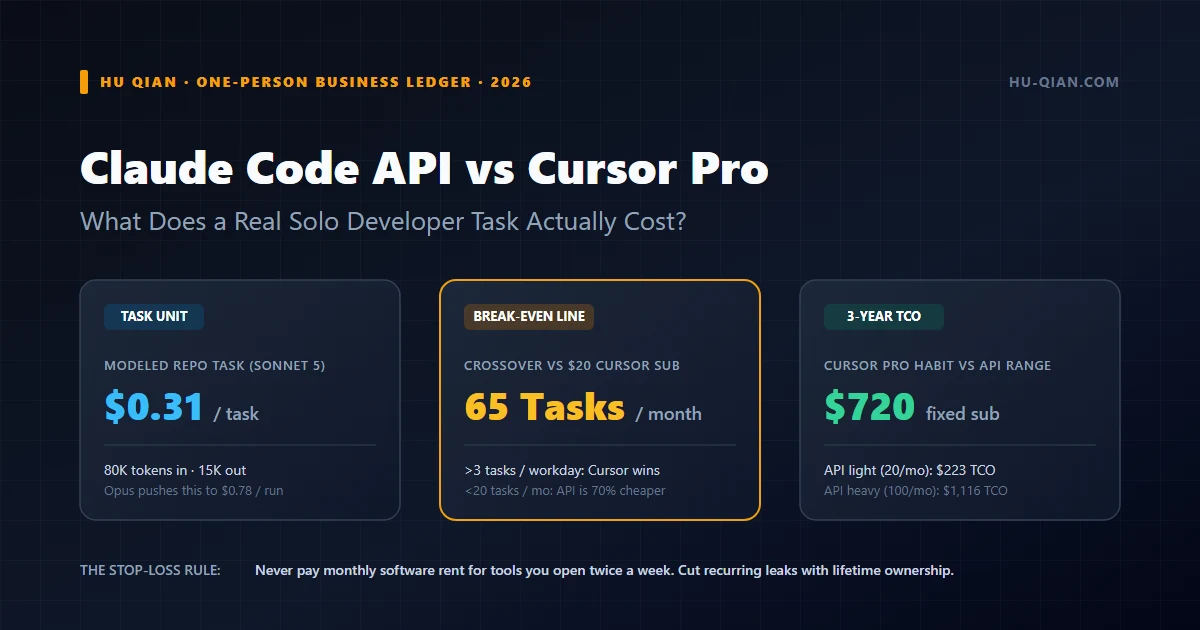
I modeled one standardized repository task three ways on September 18, 2026, and got a $0.47 Sonnet result, a $0.78 Opus result, and a $20 Cursor Pro threshold. My judgment is simple: the API wins when work is occasional and measurable; Cursor Pro wins when the editor is part of your daily operating system. The surprise is that Cursor is not an unlimited flat-rate escape from token economics. It bundles an agent-usage allowance and then returns you to usage-based billing.
Quick Verdict & Solo Developer Stop-Loss Card
Use Claude Code with API billing only when you can see the task count, check /cost, and stop the session. Buy Cursor Pro when you use agentic editing most working days and value the IDE workflow in addition to the included usage.
| Decision point | What the pricing page says | What the ledger means for one person |
|---|---|---|
| Cursor Pro | $20/month with extended Agent limits | The plan includes an allowance in the third-party model pool, charged at each model’s API price; it is not an unlimited Sonnet or Opus bucket, and Cursor does not publish a dollar value for that allowance |
| Claude Sonnet 4.6 API | $3/MTok input and $15/MTok output | A modeled 80K-input/15K-output task costs $0.47 before cache savings |
| Claude Opus 4.7 API | $5/MTok input and $25/MTok output | The same modeled task costs $0.775, so model choice moves the break-even point faster than the editor choice |
| Long sessions | Every turn resends conversation history, project context, and the new prompt | A session can get more expensive even when the visible task has not changed |
My stop-loss rules:
- If you run fewer than 20 medium repository tasks a month, then keep Claude Code on API billing and review
/costafter every session. - If you run about 43 uncached Sonnet-sized tasks a month, then test Cursor Pro for one billing cycle, because under that one modeled envelope your API spend has crossed $20.
- If a Claude Code session passes $2 before producing a verified diff, then stop, run
/clearor/compact, and narrow the task. - If you cannot explain the acceptance criteria in five bullet points, then do not hand the task to a long-running agent. Fix the brief first.
- If an environment variable exposes
ANTHROPIC_API_KEYwhile you intend to use a Claude subscription, then remove it before starting Claude Code. - If your web deployment does not require complex microservices, then host on fixed-rate infrastructure such as DreamHost, where the published first-year rate is $2.89 a month and the plan auto-renews at $10.99 a month.
The honest counter-argument is that Cursor Pro buys more than tokens. You get the editor, Tab completion, repository navigation, Agent, cloud agents, MCPs, skills, and hooks in one interface. API arithmetic cannot price the switching cost of leaving that workflow. It can only tell you when the meter has stopped being small.
The Official Price Inputs
I read the current vendor pages on 18 September 2026. The table below separates subscription price from model inference price because combining them into one vague “AI coding cost” creates the wrong comparison.
| Product or model | Published price | What is included | Official source | Read date |
|---|---|---|---|---|
| Cursor Pro | $20/month | Extended Agent limits; Pro includes an allowance in the third-party model pool charged at each model’s API price, and no fixed dollar value for that allowance is published | Cursor pricing and Cursor Models & Pricing | 18 Sep 2026 |
| Cursor Pro+ | $60/month | 3× Pro Agent limits | Cursor pricing | 18 Sep 2026 |
| Cursor Ultra | $200/month | 20× Pro Agent limits | Cursor pricing | 18 Sep 2026 |
| Claude Sonnet 4.6 API | $3/MTok input; $15/MTok output | Standard global API inference; the rate published on the model page on the read date | Claude Sonnet 4.6 | 18 Sep 2026 |
| Claude Sonnet 4.6 cache read | $0.30/MTok | Reused prompt context at 0.1× base input price | Claude Sonnet 4.6 | 18 Sep 2026 |
| Claude Opus 4.7 API | $5/MTok input; $25/MTok output | Standard global API inference | Claude Opus 4.7 | 18 Sep 2026 |
| Claude Opus 4.7 cache read | $0.50/MTok | Reused prompt context at 0.1× base input price | Claude Opus 4.7 | 18 Sep 2026 |
Taxes are excluded from Cursor’s displayed prices. Anthropic’s figures are token rates, not a promised cost per task. You need a task model before the numbers become useful.
What “One Real Task” Means in This Ledger
There is no universal cost for “fix the bug.” Repository size, files read, terminal output, retries, model choice, and conversation history all change the bill. Calling one anecdotal session a benchmark would be false precision.
I use three transparent token envelopes instead. They are modeled workloads, not my personal bills and not vendor benchmarks:
| Modeled task | Input tokens | Output tokens | Example scope | Sonnet 4.6 cost | Opus 4.7 cost |
|---|---|---|---|---|---|
| Small fix | 20K | 3K | Read a few files, change one narrow behavior, run a focused check | $0.11 | $0.175 |
| Medium repository task | 80K | 15K | Inspect a feature path, edit several files, run checks, correct one failed attempt | $0.47 | $0.775 |
| Long refactor | 250K | 35K | Read a wider code path, make multi-file changes, process more command output | $1.28 | $2.125 |
The formula is deliberately boring:
input tokens ÷ 1,000,000 × input rate + output tokens ÷ 1,000,000 × output rate
For the medium Sonnet task:
80,000 ÷ 1,000,000 × $3 + 15,000 ÷ 1,000,000 × $15 = $0.465
For the same task on Opus:
80,000 ÷ 1,000,000 × $5 + 15,000 ÷ 1,000,000 × $25 = $0.775
The output side matters. Fifteen thousand Sonnet output tokens cost $0.225, almost half the task total. If you ask the agent to narrate every choice, repeat code, or generate large reports you do not use, you pay for that verbosity.
The Break-Even Point Is 43 Tasks — Until Caching Moves It
At the uncached medium-task assumption, Cursor Pro’s $20 sticker price equals about 43 Sonnet tasks:
$20 ÷ $0.465 = 43.0 tasks
Opus reaches the same $20 line at about 26 tasks:
$20 ÷ $0.775 = 25.8 tasks
This is not proof that Cursor supplies exactly 43 Sonnet tasks. Cursor says its third-party model pool is consumed at each model’s API price, and that on-demand usage is available after the included allowance is exhausted; it does not publish a dollar value for that allowance. The 43-task line is a purchasing threshold under one stated token envelope, not a quota claim.
Caching changes the API side. If 60K of the medium task’s 80K input tokens are cache reads, the Sonnet calculation becomes:
20K uncached input × $3/MTok + 60K cached input × $0.30/MTok + 15K output × $15/MTok = $0.303
That moves the $20 line from about 43 tasks to about 66 tasks. The equivalent Opus task falls from $0.775 to $0.505, moving its $20 line to about 40 tasks.
Do not treat caching as a guaranteed discount. Cache effectiveness depends on repeated context and correct cache use. A sequence of unrelated repositories may share little reusable input.
Why Long Sessions Become Expensive
Anthropic’s Claude Code documentation explains the mechanism directly: every turn sends the conversation so far, project context such as CLAUDE.md and files already read, and the new prompt. Conversation history grows fastest.
You can ask the same visible question on turn two and turn twenty, but turn twenty may carry many more tokens. Terminal output, error messages, file contents, and earlier diffs become input again. The task did not become ten times more valuable. The context became heavier.
I would not run an API-billed debugging session as one permanent thread. If the agent has already found the root cause, I start a clean execution session with the confirmed diagnosis and acceptance checks. That preserves the useful conclusion without dragging the full investigation behind every turn.
Anthropic exposes the controls:
/costshows current session token and dollar usage for API billing./contextshows what is loaded./compactsummarizes older history./clearstarts a fresh conversation while project memory remains available./statusshows the active authentication method.
The authentication check matters because Claude Code prioritizes an ANTHROPIC_API_KEY environment variable over a logged-in Claude subscription. You can believe you are using included subscription capacity while the Console account is being charged per token. Check it.
Three-Year TCO: The Habit Costs More Than the Task
A three-year view matters here because a one-month comparison hides the cost of an automatic habit. The figures below hold today’s prices constant for 36 months. They are planning scenarios, not price guarantees.
| Usage pattern | Monthly cost at current rates | 36-month TCO | Source and read date |
|---|---|---|---|
| Cursor Pro subscription | $20.00 | $720.00 | Cursor pricing, read 18 Sep 2026 |
| 20 medium Sonnet API tasks/month | $9.30 | $334.80 | Anthropic Sonnet 4.6 rates, read 18 Sep 2026; modeled at $0.465/task |
| 43 medium Sonnet API tasks/month | $20.00 | $720.00 | Anthropic Sonnet 4.6 rates, read 18 Sep 2026; modeled at $0.465/task |
| 100 medium Sonnet API tasks/month | $46.50 | $1,674.00 | Anthropic Sonnet 4.6 rates, read 18 Sep 2026; modeled at $0.465/task |
| 20 medium Opus API tasks/month | $15.50 | $558.00 | Anthropic Opus 4.7 rates, read 18 Sep 2026; modeled at $0.775/task |
| 26 medium Opus API tasks/month | $20.15 | $725.40 | Anthropic Opus 4.7 rates, read 18 Sep 2026; modeled at $0.775/task |
| 100 medium Opus API tasks/month | $77.50 | $2,790.00 | Anthropic Opus 4.7 rates, read 18 Sep 2026; modeled at $0.775/task |
The cheap plan is not automatically the cheaper decision. Cursor Pro costs $720 over three years even if you stop coding for six months. API billing can stay below $335 over three years at 20 medium Sonnet tasks a month, but it can pass $1,670 at 100 tasks a month.
I would not buy Cursor Pro for a weekend project with five narrow tasks a month. The upgrade buys a daily editor workflow and an included usage pool. You are one person. If you are not opening that editor most working days, you will not use the workflow you keep renewing.
I would also not leave Claude Code on an unrestricted API key for daily, open-ended agent work. The API has no usage cap. Your discipline is the cap.
Before you commit to either recurring bill, run the unit economics of the project it is meant to pay for in the Project Profit Planner. A $20 tool subscription only makes sense if the project it supports clears more than that after you subtract every other line item.
Where Cursor Pro Actually Earns the Extra Money
Cursor Pro is worth buying when the non-token layer saves time: repository search, inline edits, Tab completion, model switching, Agent review, MCP integration, and one place to inspect usage. If you already work in Cursor every day, the $20 is not just pre-purchased inference.
That is the strongest case for the subscription. The comparison fails if you value only raw tokens and ignore the interface.
The mismatch appears when a solo developer moves up the pricing ladder for team-shaped benefits or unused capacity. Pro+ is $60 a month. Ultra is $200. If you cannot point to the included usage you exhausted in the dashboard, I would not upgrade. Buy evidence, not anxiety.
When the Token Drain Has No Ceiling, Buy the Outcome
Metered agentic work is at its worst on tasks that are long, well-specified, and boring: migrating an old codebase, wiring up an API integration nobody wants to write, building a one-off automation script. Those are exactly the tasks where a human loop of trial-and-error burns tokens in a cycle — you run it, it fails, you re-prompt, it burns more context — and where the cost curve has no natural ceiling.
If a task is defined well enough that you could describe the acceptance criteria in a paragraph, that is a signal to price the deliverable rather than the process.
The judgment call is not “outsourcing is cheaper.” It is that a defined deliverable has a fixed price and an undefined agentic session does not — and a one-person business is much better at absorbing the former.
The Deployment Ledger: Do Not Escape Token Rent Just to Pay Cloud Rent
When you calculate whether a $20 coding subscription makes mathematical sense, look at the other rows in your operational statement. Many solo developers manage their token burn down to the penny with Claude Code and Cursor, only to deploy on complex cloud platforms where bandwidth spikes and database charges create a second uncapped billing meter.
That is where infrastructure expenses quietly kill bootstrapped runway. You need a fast, responsive coding environment. You do not need to hand cloud providers an open-ended monthly charge for a lean product that only requires stable hosting.
For web hosting and early deployment outside enterprise architectures, my rule is straightforward: cap infrastructure risk with predictable, fixed-rate hosting before scaling.
Fixed-Rate Hosting for Simple Deployments
DreamHost is one of the entry-level fixed-rate options for deploying a static site, a landing page, or a small client site. Its published terms are easy to misread, so here they are in full: Web Hosting Launch is $2.89/month for the first year and auto-renews at $10.99/month; the plan includes 25 GB NVMe SSD storage and unmetered bandwidth; the bundled domain is free for the first year only; and there is a 30-day money-back guarantee (DreamHost hosting page, read 18 Sep 2026). That is a promotional first year followed by a standard renewal rate — not a three-year fixed price — and the domain becomes a separate renewal line from year two.
For an illustrative $25/month hosting budget, 36 months would total $900. Using the DreamHost rates listed above, and assuming the renewal rate remains unchanged, hosting alone would total $298.44 over the same period, excluding domain renewals, taxes, and optional extras. This is a budget comparison, not a like-for-like comparison of hosting capabilities. DreamHost does advertise a lower headline figure ($1.99/month), but that rate requires prepaying a four-year term and renewing at $7.99/month afterwards; it is neither a three-year price nor the first-year rate.
My Final Buying Rule
I keep the choice tied to workload shape:
- Under 20 modeled medium tasks a month: API billing is materially cheaper at the Sonnet rate used in this ledger. Keep the key temporary, watch
/cost, and clear long sessions. - Around 43 uncached Sonnet tasks a month: Cursor Pro and direct API spend meet near the same $20 line. Choose based on whether the editor workflow saves time.
- Daily Agent use: Start with Cursor Pro, inspect the dashboard before moving to Pro+, and enable on-demand usage only with a spending limit.
- Opus-heavy work: Plan with Opus, execute with Sonnet when the task allows it. Output tokens make repeated Opus execution expensive quickly.
- Deployment infrastructure: Keep recurring software spend capped, but read the renewal price and the domain terms before you commit. A cheap first year is not a cheap three years.
The real unit is not “one prompt.” It is one verified change: code edited, tests run, acceptance criteria met. I only count a task when the result survives that check.
Where to Compare Next
- Cursor vs Copilot vs Claude Code: 3-Way Real Costs — evaluate the practical workflow split between inline completions, IDE agent composer mode, and long terminal sessions.
- Cursor Pricing & Hidden Caps — single-tool deep dive into relative agent limits, plan overage mechanics, and on-demand pricing.
- One-Person Business Software Toolkit — keeping developer subscriptions lean alongside website hosting and operations.
Sources and Calculation Boundaries
Official sources read 18 September 2026:
- Cursor pricing: Hobby, Pro $20/month, Pro+ $60/month, Ultra $200/month, and relative Agent limits.
- Cursor Models & Pricing: the two usage pools, model-dependent consumption, dashboard visibility, and on-demand usage after the included allowance.
- Claude Sonnet 4.6 and Claude Opus 4.7: Sonnet 4.6 at $3/$15 with a $0.30 cache read, Opus 4.7 at $5/$25 with a $0.50 cache read. Anthropic lists both among its older models that remain available; the rates above are the ones published on these pages.
- Anthropic Claude Code usage and limits:
/cost,/context,/compact,/clear, and the mechanism that resends conversation history. - Anthropic API-key environment guidance: API keys take priority over subscription authentication.
- DreamHost Web Hosting: Web Hosting Launch at $2.89/month for the first year, auto-renewing at $10.99/month; 25 GB NVMe SSD; unmetered bandwidth; free domain for the first year; 30-day money-back guarantee (read 18 Sep 2026). DreamHost displays these prices in USD or the visitor’s local currency depending on region.
Calculation boundaries:
- The 20K/3K, 80K/15K, and 250K/35K task envelopes are transparent editorial models. They are not measured personal sessions, customer bills, or vendor averages.
- API task costs exclude taxes, regional inference premiums, server-side web search charges, and optional fast-mode premiums.
- Cursor does not publish a fixed dollar value for the third-party model allowance, so no dollar value is assumed for it anywhere in this ledger.
- Three-year figures hold the 18 September 2026 prices constant. Vendors can change prices, included usage, and model availability.
- DreamHost is evaluated for independent web deployments, not for complex multi-region enterprise clusters.
- The 43-task and 26-task break-even lines are theoretical thresholds under one stated token envelope (80K input / 15K output, uncached). They are not the result of long-run measurement across a developer population: real context growth, retries, and multi-turn sessions change consumption substantially, so treat any single figure as an illustration rather than an expected bill.
- The DreamHost three-year figure is a modeled total built from the published first-year and renewal rates. Domain renewal from year two is excluded because the vendor does not publish that rate on the cited page, so the true three-year cost is at or above $298.44.