
If you are comparing Fiverr vs Upwork for a small business, use Fiverr for a narrow task with a clear deliverable and Upwork for work that needs active discovery, interviews, or a longer working relationship. My rule of thumb: Fiverr is usually the faster first test; Upwork earns its extra setup time when the brief is fuzzy or the work will keep changing. Count your hours, not just the platform fee.
If your task already fits on one screen, you can compare Fiverr packages for it before reading the full breakdown.
The Afternoon I Bought the Wrong Kind of Help
I once spent an afternoon hiring a designer for a landing-page illustration. I started on a marketplace with a long list of proposals, opened six tabs, wrote the same context three times, and still chose a person whose idea of “close enough” was a rectangle with a shadow. The invoice was not the expensive part. The expensive part was losing a workday and then doing the job myself at 11:40 p.m.
That mistake changed how I compare marketplaces. I stopped asking which platform looks more professional and started asking which one removes the most work from my calendar. A low fee is irrelevant if the hiring process becomes a part-time job.
Fiverr vs Upwork for Small Business: The Time Ledger
The two platforms ask you to do different kinds of labor.
On Fiverr, you browse packaged offers. You inspect samples, read reviews, ask one or two questions, and place a small order. The seller has already turned part of the brief into a menu item. That limits flexibility, which is exactly why it can save time.
On Upwork, you usually write a post, describe the project, review proposals, compare profiles, interview candidates, choose a contract, and manage the first handoff. That is more work up front. It can also be the right work when you need someone to understand your business instead of merely completing a defined task.
Here are my rough planning numbers for a first hire. They are author estimates, not platform data. A narrow Fiverr task takes about 2.5 hours across browsing, briefing, review, and handoff. A first Upwork hire takes about 5.5 hours when posting, shortlisting, interviews, contract setup, and the first review are included.
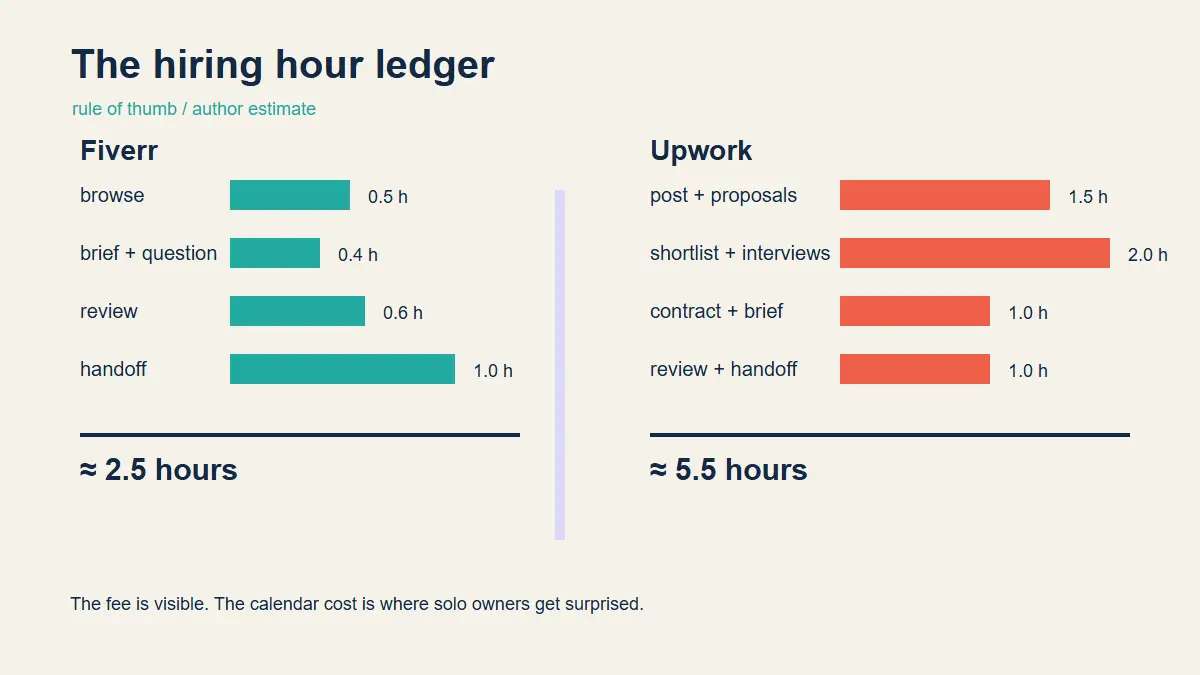
It is a calendar entry. If your task is worth $40 and you spend five hours finding help, you bought paperwork, not leverage.
Stage 1: Post or Browse Without Lying to Yourself
Fiverr starts with browsing. The seller has named the service, shown a package, and usually listed a delivery window. You can reject the offer quickly if the examples are wrong or the package is vague.
Upwork starts with your own description. That sounds efficient until you are staring at a blank box trying to explain a problem you barely understand. The quality of the brief controls the quality of the proposals. A vague post creates a small parade of confident guesses.
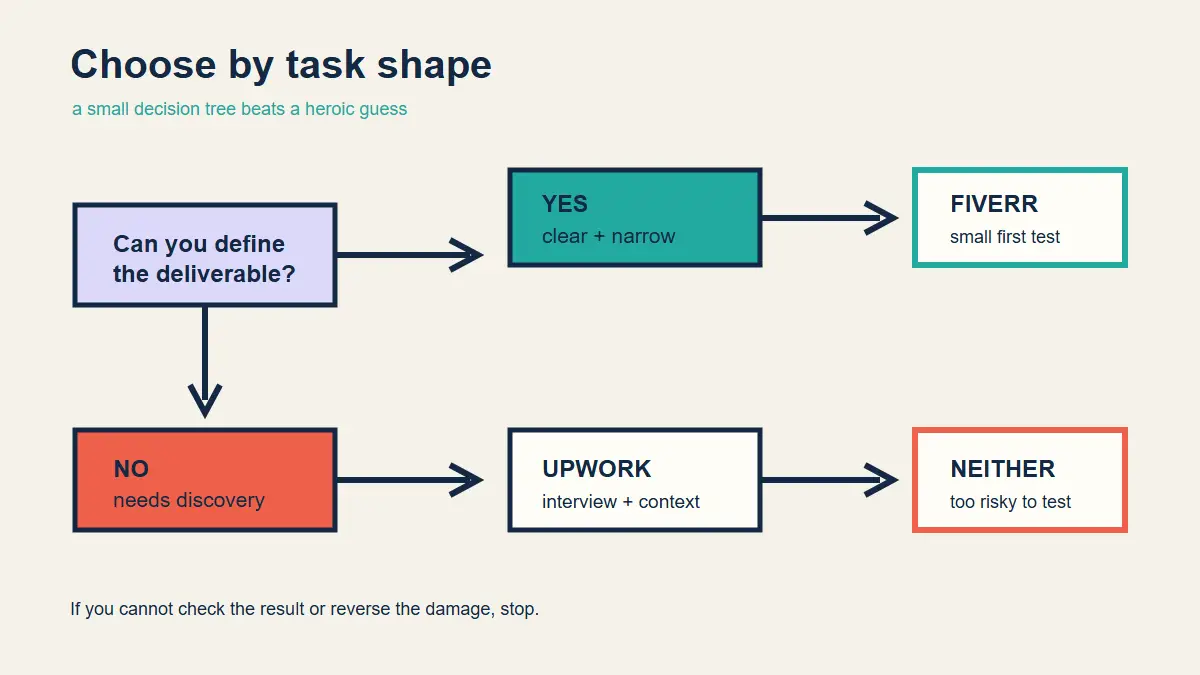
Choose Fiverr when the output is easy to point at: a thumbnail, a short translation, a simple spreadsheet cleanup, or a fixed design variation. Choose Upwork when the work needs discovery, custom research, or a conversation before anyone can quote it honestly.
Stage 2: Shortlist Without Turning Into a Recruiter
Fiverr gives you a visible shortlist almost immediately. The trap is assuming that a high star rating is enough. Read the samples. Check whether the seller explains the process. Ask what you receive at the end. If you need a quick filter, use how to spot a bad Fiverr seller.
Upwork gives you more context, but context is work. You may compare employment history, proposal quality, rates, and availability. You may also discover that three candidates misunderstood the same sentence in your brief. That evidence still costs time.
My shortcut is simple. For a small, repeatable task, shortlist three Fiverr offers and stop. For a high-context project, shortlist three Upwork candidates and ask each the same specific question. If you cannot compare their answers, the project is not ready to outsource.
Stage 3: Briefing and Revisions
A packaged Fiverr order works best when the brief can fit on one screen. Give the seller the goal, the exact inputs, the output format, and one example of what “good” looks like. Do not send a life story and call it a specification.
Upwork is better when the brief needs discussion. You can test how a candidate thinks before signing a longer contract. That is the hidden value of the extra time. You are buying a small interview process, not merely a file.
Revisions are where both platforms collect their tax. On Fiverr, the package may include a stated number of revisions. On Upwork, revisions are usually part of the conversation and the contract scope. In both cases, write down what counts as a revision before the first draft arrives. “Make it better” is not a revision policy. It is a cry for help wearing a brief-shaped hat.
Stage 4: Payment and Handoff
Fiverr currently lists a 5.5% service fee and an additional $3.50 on orders under $200 on its buyer help page. Upwork’s public client pricing page lists a 5% Basic plan service fee and a contract initiation fee ranging from $0.99 to $14.99. Fees can change, so check the current fee page and the checkout screen before paying.
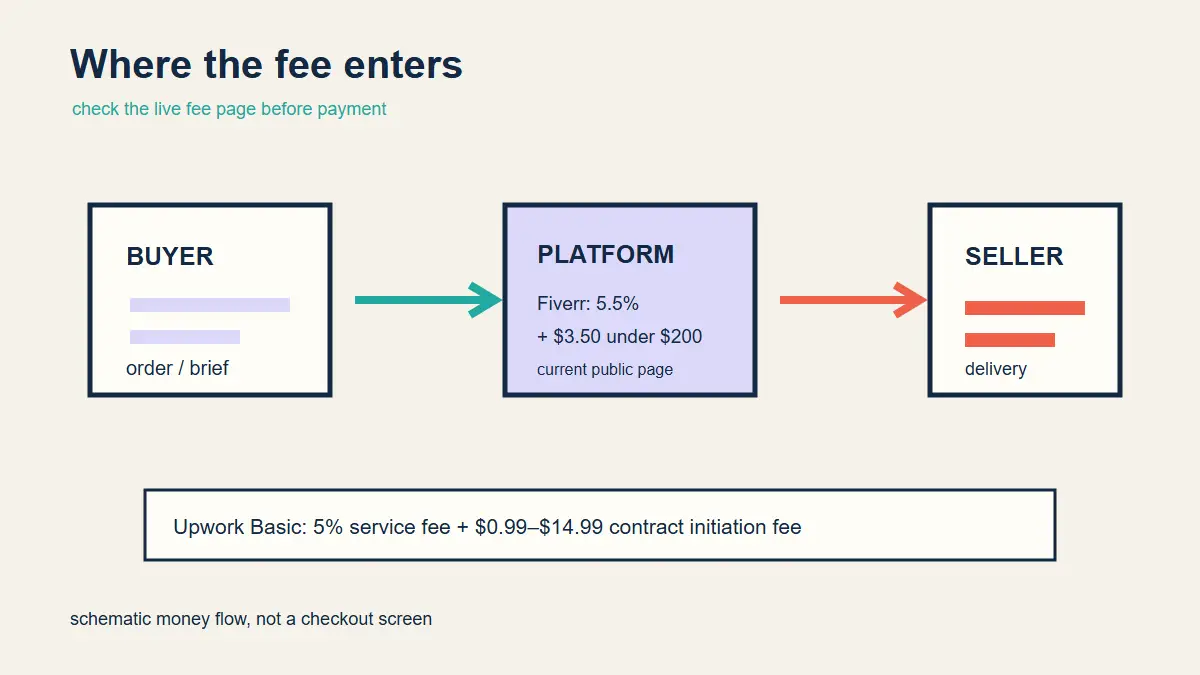
The fee difference matters less than the handoff. Ask for editable files, access details, naming conventions, and a short note explaining what changed. A finished PNG is not the same thing as a usable asset. If the work will be touched again, the handoff is part of the product.
For a first order, I keep the scope small and the budget below $50 when that is realistic. A small test tells you more about communication and delivery than a glowing profile ever will.
My Decision Rule by Task Type
Pick Fiverr for a narrow, visible deliverable
Use Fiverr for a logo variation, a fixed image resize, light copy polishing, a data cleanup, or another task where the input and output are easy to define. Browse the package. Ask one precise question. Buy the smallest useful test.
I sometimes start there when I need a fast second pair of hands: browse Fiverr packages for this kind of task. The platform does not remove judgment. It makes the first comparison faster.
Pick Upwork for ongoing, ambiguous, or high-context work
Use Upwork when the task needs research, several rounds of discussion, access to your systems, or a person who will keep making decisions with you. The extra shortlist and interview time can prevent a larger mess later.
It also suits work where the deliverable is still fuzzy. A good candidate can turn the problem into smaller jobs.
Pick neither when the cost of being wrong is too high
Do not use either marketplace for a core product decision, sensitive payment integration, or work that needs deep context about your business and has no safe test step. Use a vetted specialist, a trusted referral, or do the first version yourself.
If you cannot explain the task, check the result, or reverse the damage, do not hire from a marketplace. The platform is not your risk department. You are.
What the First Week Actually Looks Like
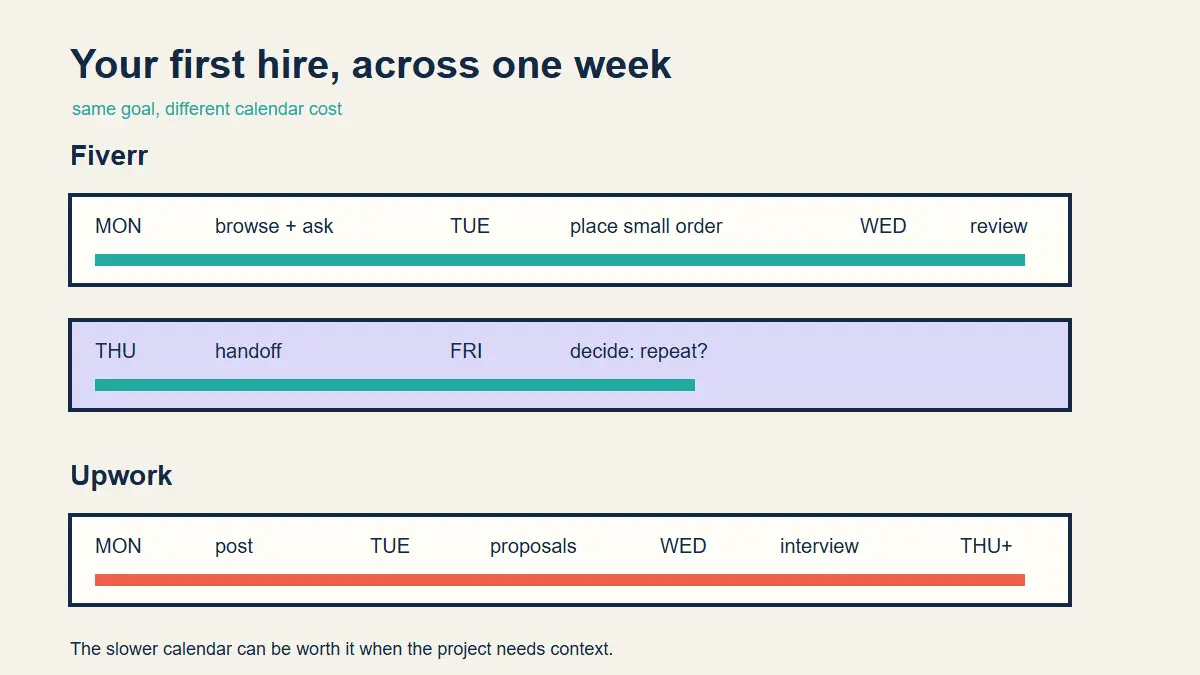
A first Fiverr hire can be compressed into one working session: browse on Monday morning, ask a question, place a small order, review the delivery, and decide whether the seller earns a second task. That speed is useful when you are testing demand or clearing a backlog.
An Upwork hire may spread across the week: write the post, wait for proposals, compare candidates, interview one or two, set the contract, then review the first handoff. The calendar is slower, but the added steps can be a sensible price for a complicated job.
Do not use the slower process for a five-line task, or the faster process for work that needs a real relationship.
If you want to run the one-session test this week, pick one small task from your backlog and start a small Fiverr test order. Keep it under $50 and judge the seller on communication and handoff, not just the file.
The practical answer to fiverr vs upwork for small business is to match the platform to the shape of the work. Use Fiverr when speed and a clear package matter. Use Upwork when context and collaboration matter. If either option asks you to spend more time managing the hire than doing the work, stop and change the plan.