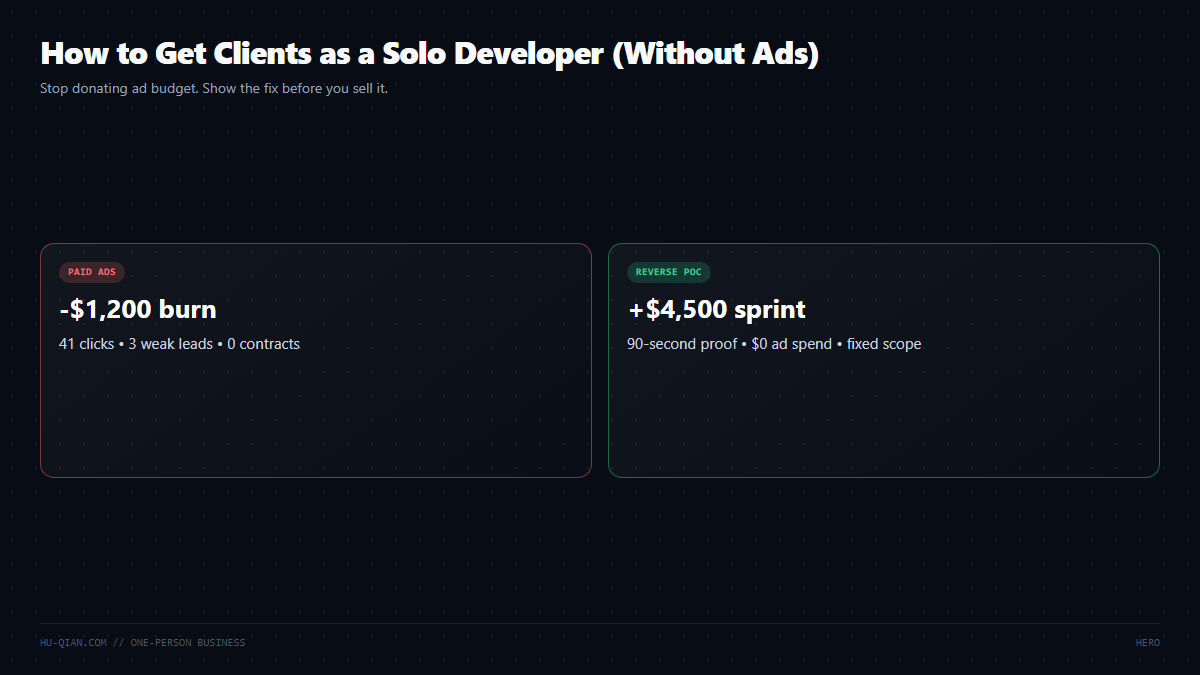
Build a small working sample (2 hours max) that solves one visible problem for a real company. Send the demo, not your resume. This gets replies faster than $1,000 in Google Ads.
I call it a Reverse Proof-of-Concept (POC): you build first, then offer. The point is not to promise a contract; it is to give a qualified prospect something concrete to judge.
Start here: one prospect, one proof, one paid next step
- Find one public operational problem in a niche you understand. Do not build for a vague audience.
- Cap the proof at two hours. Show the smallest useful fix on mock data, then record the 90-second demo.
- Offer one paid next step: the diagnostic audit. If the prospect cannot name the problem, reach the decision-maker, or accept the deposit terms, stop.
This is the smallest version worth testing. For the follow-up and delivery side, see client acquisition workflow automation. For a second no-ad channel, compare it with LinkedIn client acquisition without Sales Navigator.
The $1,200 Google Ads Post-Mortem
Two years ago, I stood in my kitchen at 6:30 AM stirring cold instant oatmeal while staring at a Google Ads notification on my phone.
Over nineteen days, my campaign had chewed through $1,214.60 targeting keywords like “freelance backend developer” and “hire nodejs engineer”.
The balance sheet of that campaign was humiliating:
- Clicks received: 41
- Average Cost Per Click (CPC): $29.62
- Form submissions: 3
- Inquiry 1: A college sophomore asking if I could write his computer science graduation project for $40.
- Inquiry 2: An “entrepreneur” who wanted an exact clone of Airbnb built for $600 and a 5% equity stake.
- Inquiry 3: A recruitment agency scraping contact details for a mid-level staffing pool in Bangalore.
- Signed contracts: Exactly zero.
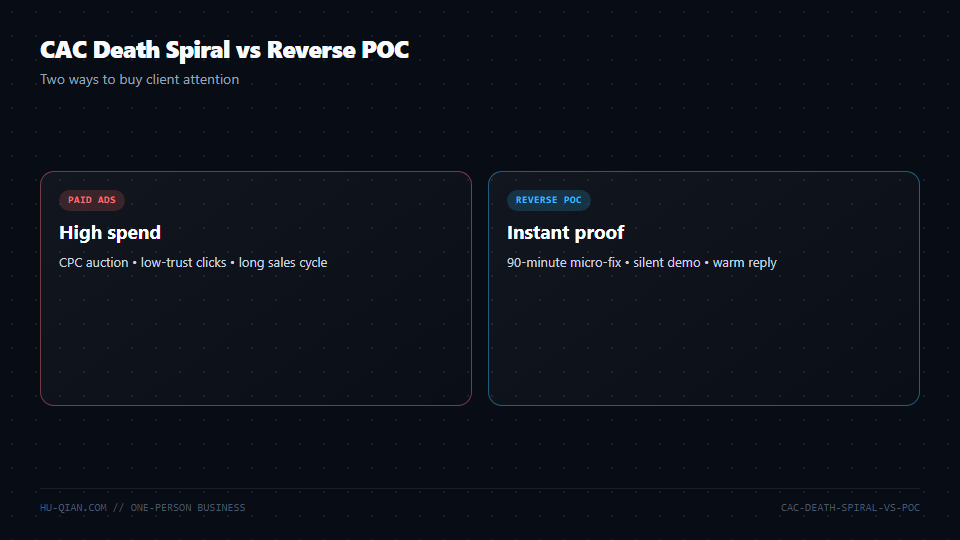
Paid advertising is an auction designed for funded agencies with $50,000 monthly burn rates and dedicated sales reps who run three-week qualification calls.
When a solo developer buys Google or LinkedIn ads, you are not buying client attention. You are donating your runway to a platform whose bidding algorithm penalizes small budgets.
Worse, paid traffic lands on your site with negative trust. They do not know who you are, they assume you are a fly-by-night contractor, and they bounce within six seconds if they do not see a 24/7 support badge.
If you are a one-person business, you do not need more impressions. You need leverage.
The Audience Vanity Trap: Why GitHub Stars Don’t Pay Rent
A common piece of advice circulating on tech Twitter is: “Just build a personal brand. Post daily code tips, grow your followers, open-source your side projects, and clients will come knocking.”
This advice sounds noble, but economically it is broken.
Take a look at the matrix below:
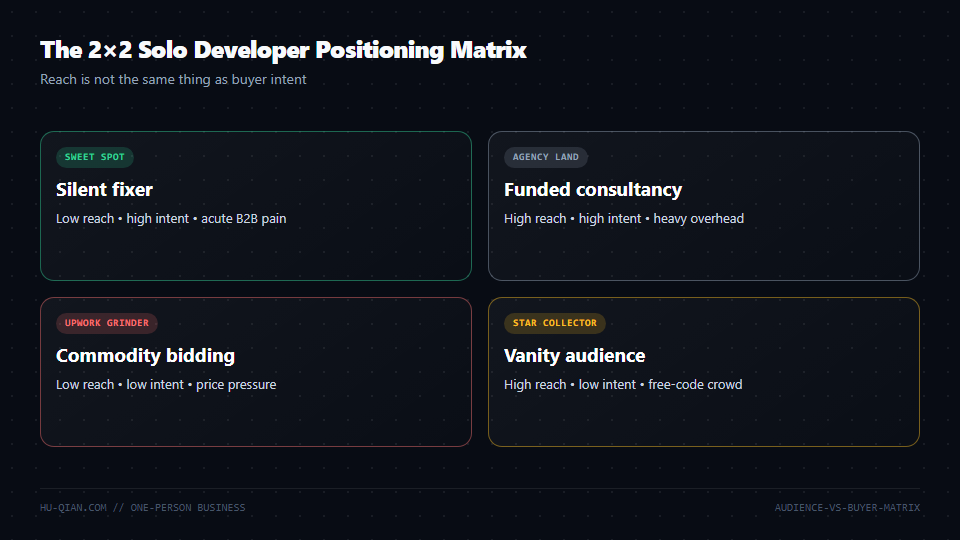
Most engineers get stuck in the bottom-right quadrant: The Star Collector Trap.
They spend forty hours building a neat open-source CSS library or a terminal dashboard. It hits the front page of Hacker News, collects 2,400 GitHub stars, and gains them 3,000 Twitter followers.
Then their rent check comes due, and their bank balance is unchanged.
Why? Because their audience consists entirely of other developers who will never pay them a single dollar. Other developers want free code, documentation, and MIT licenses. They do not have corporate purchasing authority.
The solo engineers who make a consistent $15,000 to $25,000 every month without working 80 hours a week live in the top-left quadrant: The Silent Fixer.
A Silent Fixer:
- Has practically zero social media presence.
- Does not write 20-tweet threads about clean code architecture.
- Does not compete on Upwork with 90 offshore bidders offering to work for $12 an hour.
- Focuses exclusively on acute, high-impact B2B operational bottlenecks that bleed money for business owners every single day.
When you solve a problem that costs a company $500 an hour in downtime or manual spreadsheet reconciliation, quoting $5,000 for a five-day fix is not an expense—it is a discount.
The Reverse Proof-of-Concept Engine (4-Step Blueprint)
How does a Silent Fixer get clients without cold calling, bidding on platforms, or running ads?
They reverse the standard sales pitch.
Traditional freelancing starts with words: “Hi, I have 8 years of React experience. Here is my portfolio. Can we jump on a 30-minute discovery call?”
The client ignores it because their inbox is already flooded with thirty identical emails from offshore agencies.
The Reverse Proof-of-Concept (POC) starts with working software.
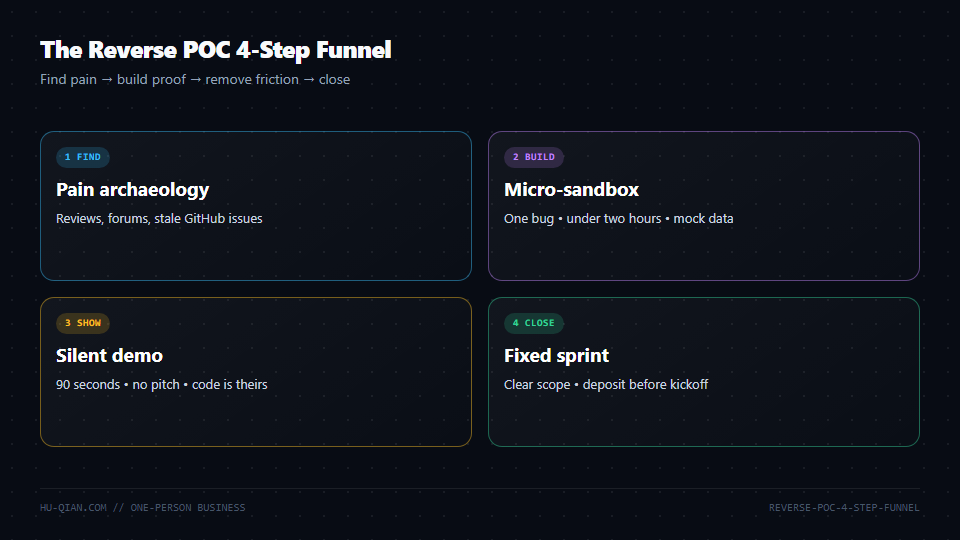
Here is the exact step-by-step mechanism:
Step 1: Pain Archaeology (Find Where They Are Bleeding)
You do not guess what companies need. You read where their users and engineers are complaining in public:
- G2 & Capterra 2-star reviews: Search for SaaS products in a specific niche (e.g., Shopify inventory sync, real estate CRM). Look for reviews saying: “Great software, but the QuickBooks export times out every week” or “The webhook doesn’t sync our multi-currency invoices.”
- Zapier & Make Community Forums: Search for threads where founders ask: “How do I connect Tool A to Tool B without hiring an agency?” and the thread ends with: “Still stuck.”
- Public GitHub Issues: Look at repositories for popular API SDKs (e.g., Stripe, Twilio, HubSpot). Search closed or stale issues for common integration workarounds that smaller businesses struggle to deploy.
Step 2: Build a 2-Hour Micro-Sandbox
Once you identify an acute bottleneck, do not write a full application.
Pick one company that fits your profile (5 to 30 employees, bootstrapped or Series A, actively running paid products).
Open your code editor, spin up a fresh repository, and write 50 to 100 lines of clean code that solves that exact failure mode.
- A retry queue worker using BullMQ that handles Stripe timeout spikes.
- A Python normalization script that transforms messy vendor CSV exports into clean database imports.
- A lightweight webhook proxy that prevents data loss during API rate limits.
Hard Rule: Never spend more than two hours on this. If it takes longer than 120 minutes, your scope is too broad.
Step 3: Record the 90-Second Silent Loom
Do not write a 500-word cover letter. Record a short video with Loom or CleanShot:
- 0:00 - 0:15: State the problem directly without introductions. “Hey Alex, noticed on your forum that several customers have issues with Zapier dropping records when order volume spikes over 500/min.”
- 0:15 - 0:50: Switch to your screen. Show your micro-sandbox running locally with mock payloads. Show the error catching, the queue retry, and the successful payload delivery.
- 0:50 - 1:15: The unselfish offer. “I wrapped this into a standalone 80-line module. The GitHub repo is attached below. Feel free to hand it to your internal team to implement—no catch.”
- 1:15 - 1:30: The low-pressure bridge. “If your team is swamped and you want this tested, hardened, and pushed to your staging environment this week, let me know. Happy to handle it.”
Step 4: The Frictionless Close
When you deliver a working solution before asking for money, you trigger a powerful psychological reflex: reciprocity and competence verification.
The founder or engineering lead does not need to guess if you know your craft—they just watched your code fix their problem in 90 seconds.
Out of 10 targeted Reverse POCs sent to qualified companies:
- 4 to 5 will reply with genuine gratitude.
- 2 to 3 will ask: “What would it cost for you to implement this on our actual infrastructure?”
You now have a warm, high-intent deal on the table without ever having sent a generic resume or spent a dollar on advertising.
The Trojan Horse Pricing Ladder
The biggest mistake developers make when a prospect asks “What would it cost?” is responding with a massive, vague estimate:
“Well, depending on requirements, it will probably take 4 to 6 weeks at $120/hour, so around $15,000 to $20,000.”
That quote immediately reintroduces risk. The client’s guard goes back up, and they disappear into internal budget discussions that take three months.
Instead, use the Trojan Horse Pricing Ladder:
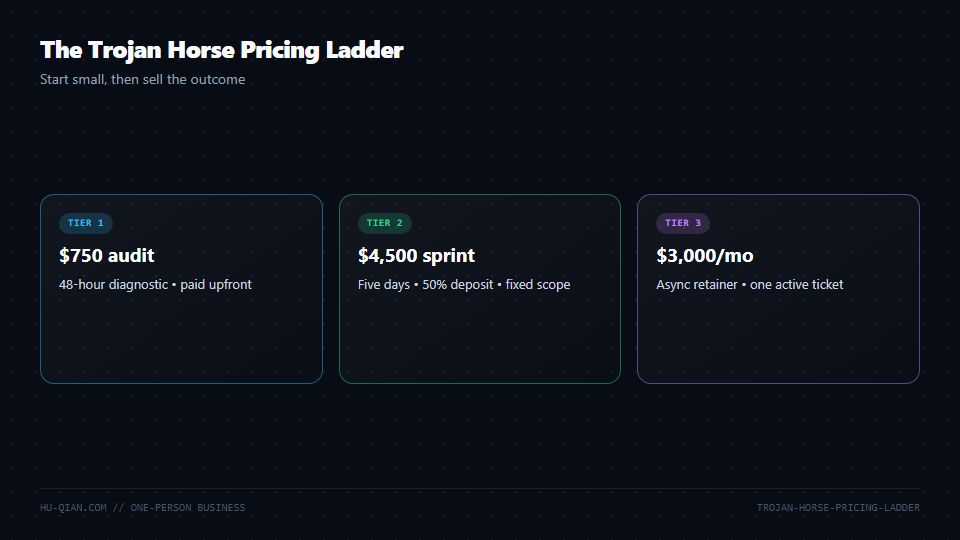
Tier 1: The $750 Micro-Audit (The Impulse Buy)
When they reply to your video, offer a diagnostic audit first:
- “Before we touch production code, let me run a 48-hour diagnostic on your current webhook pipelines and API logs to confirm there aren’t hidden bottlenecks. It’s a flat $750.”
Why this works:
- $750 is under the corporate credit card threshold for almost every business owner or tech lead. They do not need board approval or procurement review.
- It requires 100% upfront payment. The money hits your account before you start.
- You deliver a concise, 4-page technical audit highlighting three priority fixes.
Tier 2: The $4,500 Surgical Sprint (The Core Engagement)
Once you deliver the audit, you present the fix as a packaged product:
- Deliverable: Fix the two primary bottlenecks identified in the audit.
- Timeline: Exactly five business days (Monday to Friday).
- Terms: 50% non-refundable deposit upfront ($2,250), and 50% upon verified deployment to their staging environment ($2,250).
No hourly billing. No timesheets. You are selling an outcome, not your clock.
Tier 3: The $3,000/Month Async Retainer (The Cash Anchor)
After shipping the sprint successfully, the client will realize how much easier life is with a competent, reliable engineer on standby.
Before you say goodbye, offer an ongoing arrangement:
- “I take on a maximum of three fractional engineering retainers. For $3,000 a month, you get one active ticket at a time in our shared board, with a guaranteed 48-hour turnaround on PRs, async communication over Slack, and zero recurring meetings.”
With just three retainer clients, you have $9,000 in monthly recurring baseline revenue at an 85%+ gross profit margin.
You wake up on the first of every month with your bills already paid, allowing you to choose new projects on your own terms.
Parasitic Inbound: Let Enterprise App Stores Do the Prospecting
Outbound POCs are effective, but you can also build an inbound pipeline that works while you sleep—without writing 50 blog posts or waiting six months for Google SEO.
I call this Parasitic Inbound.
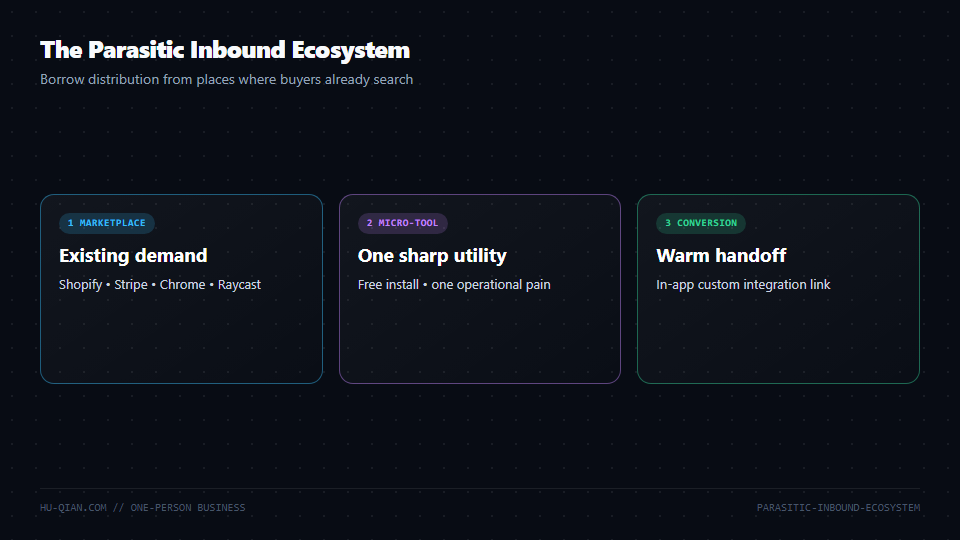
Instead of building your own audience from scratch, you tap into established software ecosystems where paying customers already spend money:
- Shopify App Store
- Stripe Apps Marketplace
- Chrome Web Store
- Raycast / Slack Store
How to Execute:
- Build a free, hyper-focused micro-utility that takes less than 300 lines of code to write. For example: A lightweight Chrome extension that parses Stripe dashboard errors into plain English, or A Shopify app that exports multi-location inventory to a clean Google Sheet.
- Publish it for free on the marketplace. Because these platforms have built-in search engines, businesses searching for that exact problem will find and install your tool within days.
- Inside the tool’s settings or dashboard, place a clean, discreet callout:
"Need a custom enterprise integration or private database sync for your store? [Talk directly to the developer]."
These users are not random web surfers. They are active store owners and operations managers who are already logged into their payment and commerce infrastructure.
A single micro-tool with 400 active business installs regularly produces 8 to 12 warm inbound inquiries per month.
Zero ad spend. Zero cold emailing. The ecosystem provides the trust; you provide the custom engineering.
Client Red Flag Triage: The Deals That Will Bankrupt Your Sanity
When you start executing this system, inquiries will arrive faster than you can fulfill them.
The biggest risk to a solo developer is not running out of leads; it is accepting the wrong client and getting trapped in a sixty-day hostage situation.
Keep this triage matrix pinned above your desk:
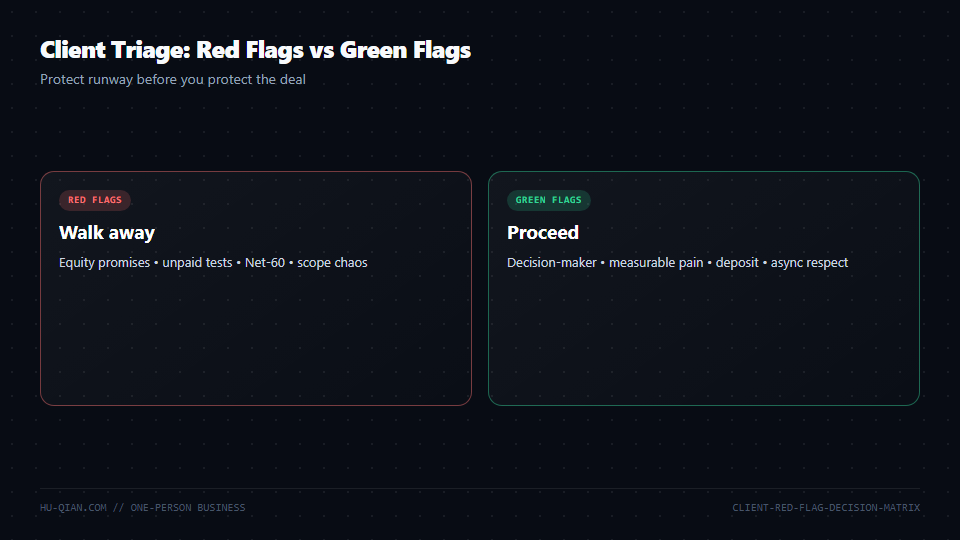
Red Flags (Disqualify Within 5 Minutes):
- “We will give you 15% equity once our seed round closes”: Equity in an unproven concept is worth zero dollars. Never trade engineering hours for lottery tickets unless your living expenses are funded for three years.
- 25-Page Mutual NDA Before Explaining the Problem: Heavy legal friction on day one indicates high corporate insecurity and low execution speed.
- “Our last three dev agencies were complete idiots”: If every contractor they hired failed, the problem is not the contractors. It is the client’s erratic scope management.
- Unpaid “Test Tasks”: If a client asks for three days of free coding after watching your proof-of-concept, they are harvesting free labor. Walk away immediately.
- Net-60 Payment Terms: Solo businesses cannot act as zero-interest banks for enterprise clients. If they cannot wire a 50% deposit upfront, you cannot book the sprint.
Green Flags (Close and Ship):
- You deal directly with the decision-maker (Founder, CTO, or VP of Ops) who has direct sign-off authority.
- The problem is tied to a quantifiable cost (e.g., “Our customer support spends 12 hours a week manually fixing failed syncing jobs”).
- They agree to a 50% non-refundable upfront deposit without hesitation.
- They respect asynchronous communication and prefer clear Slack updates over daily 45-minute video standups.
The Solo Developer’s 48-Hour Action Plan
You do not need to redesign your portfolio website this weekend. You do not need a new logo, a business card, or a Google Ads account.
Here is what you do over the next 48 hours:
- Monday Morning (Identify): Spend three hours reading Capterra reviews and Zapier community threads in one niche you understand (e.g., e-commerce logistics, real estate CRM, billing automation). Pick 3 companies suffering from a specific, recurring technical bottleneck.
- Monday Afternoon (Build): Pick the first company. Build an 80-line standalone code fix that resolves their exact issue. Cap your time at two hours.
- Tuesday Morning (Record & Deliver): Record a 90-second Loom showing the fix running on mock data. Send it directly to their CTO or founder with the free GitHub link.
- Wednesday (Follow-Up): If they reply, offer the $750 48-hour diagnostic audit to verify their production environment. Once completed, pitch the $4,500 5-day surgical sprint.
Stop waiting for clients to discover your website. Build the proof first, eliminate their risk, and let your competence do the selling.
Frequently Asked Questions
Why do paid ads fail so consistently for solo developers?
Paid search and social ads depend on broad volume and low-touch conversion. At $18 to $45 per click, solo engineers cannot absorb the cost of non-converting traffic. Enterprise decision-makers rarely hire technical consultants via sponsored banner ads; they hire through peer referrals or direct demonstrations of competence.
What if a prospect takes my free POC code and doesn’t hire me?
That is an expected part of the model, and it costs you nothing. You spent 90 minutes building a modular script that you can easily adapt for other companies in the same industry. More importantly, when that company runs into a more complex infrastructure issue three months later, who do you think they will contact first? The developer who sent them a working solution for free.
Should I charge hourly or fixed pricing as a solo developer?
Always charge fixed, value-anchored project fees. Hourly billing penalizes you for being fast and skilled: as your expertise increases and you solve problems quicker, your revenue decreases. Fixed-scope sprints (e.g., $4,500 for a five-day sprint) align incentives: the client gets guaranteed delivery on a set date, and you capture the full value of your efficiency.
How do I handle contracts and legal agreements without an agency lawyer?
Keep your contract down to two pages. State the exact deliverables, the acceptance criteria, the staging delivery date, and the payment schedule (50% deposit before kickoff, 50% upon verified staging handoff). Include a clear clause stating that production deployment only occurs after the final payment has cleared.