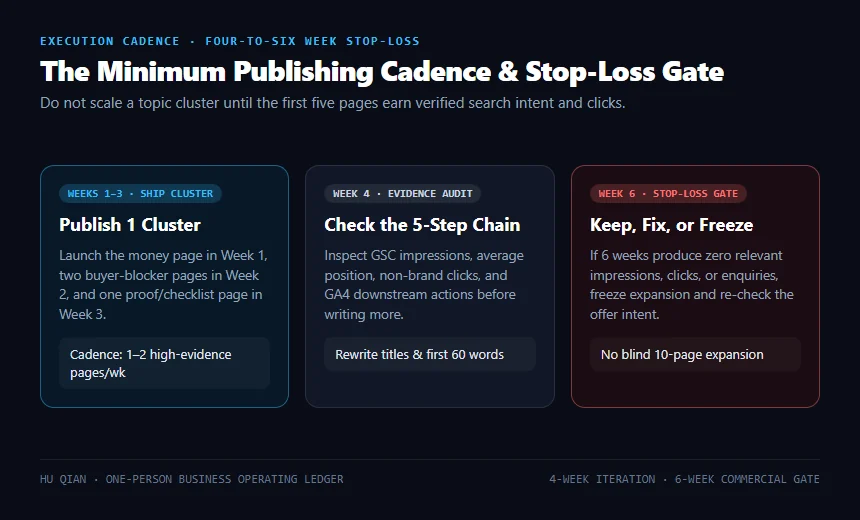
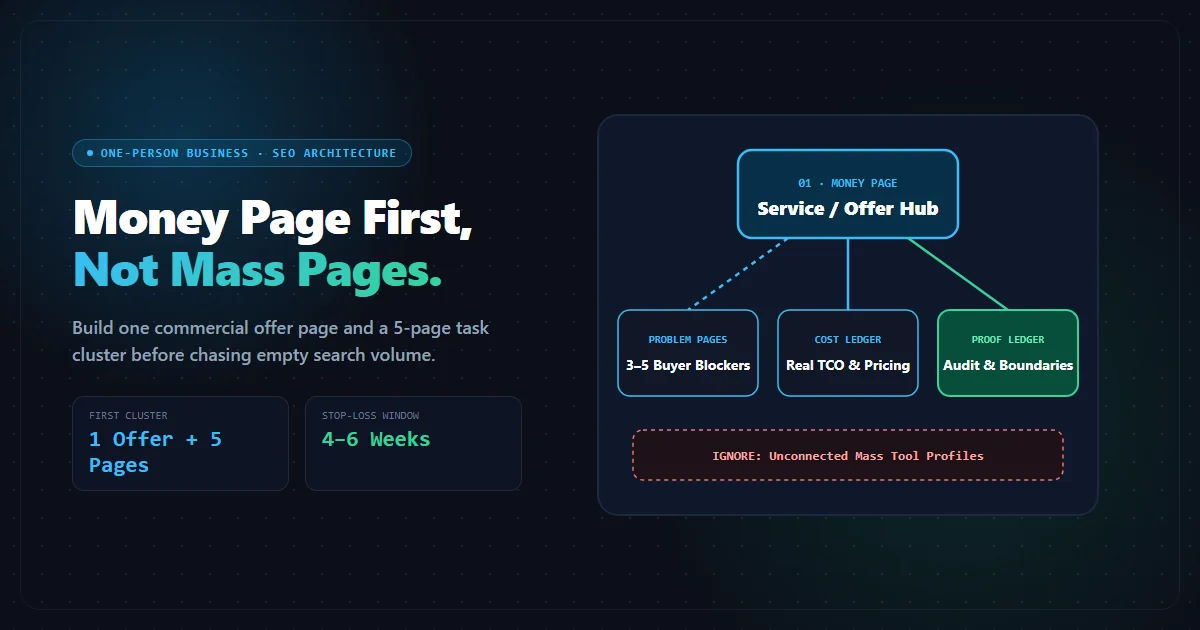
A one-person business does not need a large SEO site first. It needs one page that explains a valuable offer, a small set of supporting answers, and a way to tell whether the work produced qualified attention. Build the commercial path before the publishing machine.
Start with the page that can create a conversation
The first page should usually be a service page, productized offer, or decision page—not a generic blog post. It must answer four questions quickly:
- Who is this for?
- What expensive or urgent problem does it solve?
- What does the buyer receive?
- What should the buyer do next?
For a solo developer, that might be a narrowly scoped audit, migration, or implementation package. For a consultant, it might be a diagnostic call with a defined deliverable. For a creator, it might be a paid template or a small membership. The exact offer varies; the rule does not: SEO should point toward a transaction or a qualified conversation.
If the site is still deciding between a blog, service page, and tool, use the Wix real-cost ledger as a platform decision example—but do not confuse choosing a builder with creating demand.
Build one topic cluster around one business task
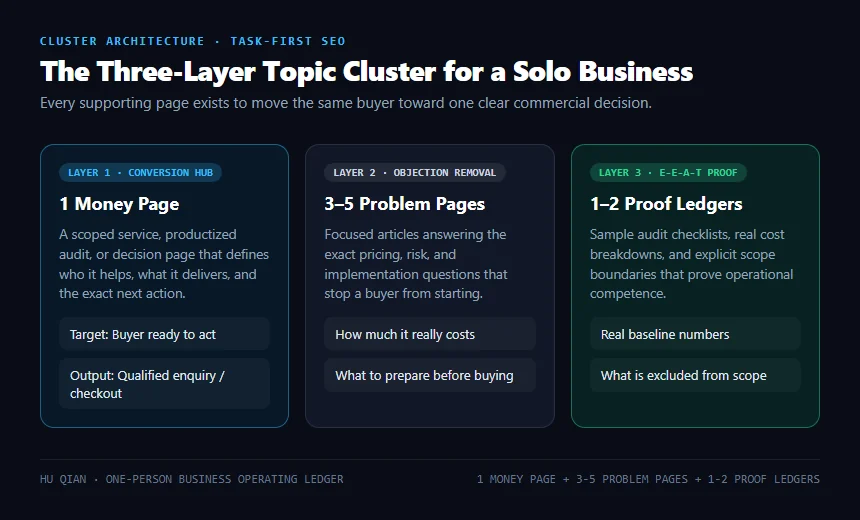
A practical first cluster has three layers:
- Money page: the offer, service, or decision page.
- Problem pages: three to five articles answering the questions that stop the buyer from acting.
- Proof and process pages: a case ledger, checklist, methodology page, or transparent comparison that shows how you work.
For example, a solo developer who sells website audits might build:
- a service page for the audit;
- “how to find the first three website problems”;
- “how much a website audit costs”;
- “what to prepare before hiring an auditor”;
- a sample findings checklist;
- a page explaining what the audit does not include.
That is stronger than publishing twenty unrelated reviews because every page helps the same buyer move closer to a decision.
What to ignore at the beginning
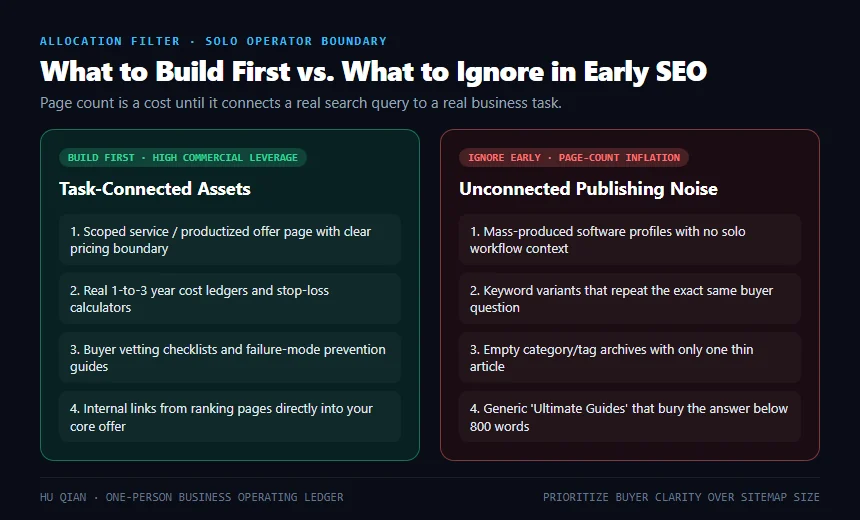
Ignore work that increases page count without increasing evidence or buyer clarity:
- mass-produced software profiles with no task context;
- keyword variants that answer the same question;
- tags and category pages with one thin article;
- generic “ultimate guide” introductions that delay the answer;
- tool comparisons without a decision rule;
- traffic screenshots without a defined conversion event.
The site may still contain older tool pages. Do not delete or rewrite all of them at once. First stop promoting them as the site identity, then connect the useful ones to a business task. A tool page earns its place when it helps the reader acquire, deliver, or retain business.
Use a simple evidence loop
Measure SEO in this order:
- Impressions: did Google test the page for a relevant query?
- Position: is the page close enough to earn a click?
- Clicks: did a real searcher enter?
- Next action: did the visitor read, subscribe, enquire, or click a verified offer?
- Commercial result: was anything approved, paid, or settled?
Do not treat a sitemap submission, a page build, or a direct visit as revenue evidence. On this site, the recent GSC snapshot showed 46 impressions and 0 clicks over 28 days. That is enough to justify improving the commercial path; it is not enough to claim SEO traction.
For a paid SEO tool such as Surfer, see the Surfer SEO pricing and ROI review. The tool may help organise work, but it cannot replace a useful offer, a credible proof point, or distribution.
The minimum publishing cadence
Publish two or three tightly related pages per week only when each page has a different job in the same buyer journey. A reasonable four-week sequence is:
- Week 1: money page and one problem page.
- Week 2: cost or comparison page and a preparation checklist.
- Week 3: proof page and a narrow objection-handling page.
- Week 4: improve titles, introductions, internal links, and calls to action using the actual query and page data.
The goal is not to maintain a daily streak. The goal is to make the next page more useful because the previous page revealed a real question, objection, or failure mode.
A stop-loss rule for SEO work
Set a review date and a measurable threshold before expanding the cluster. For example: after four to six weeks, keep the cluster only if it produces relevant impressions, at least one non-brand click, a real enquiry, or a clear production saving. If none appears, do not automatically publish ten more pages. Re-check the offer, query intent, evidence, and distribution channel.
A one-person business wins SEO by narrowing the promise until the right reader recognises it—not by becoming a smaller version of a large media site.