
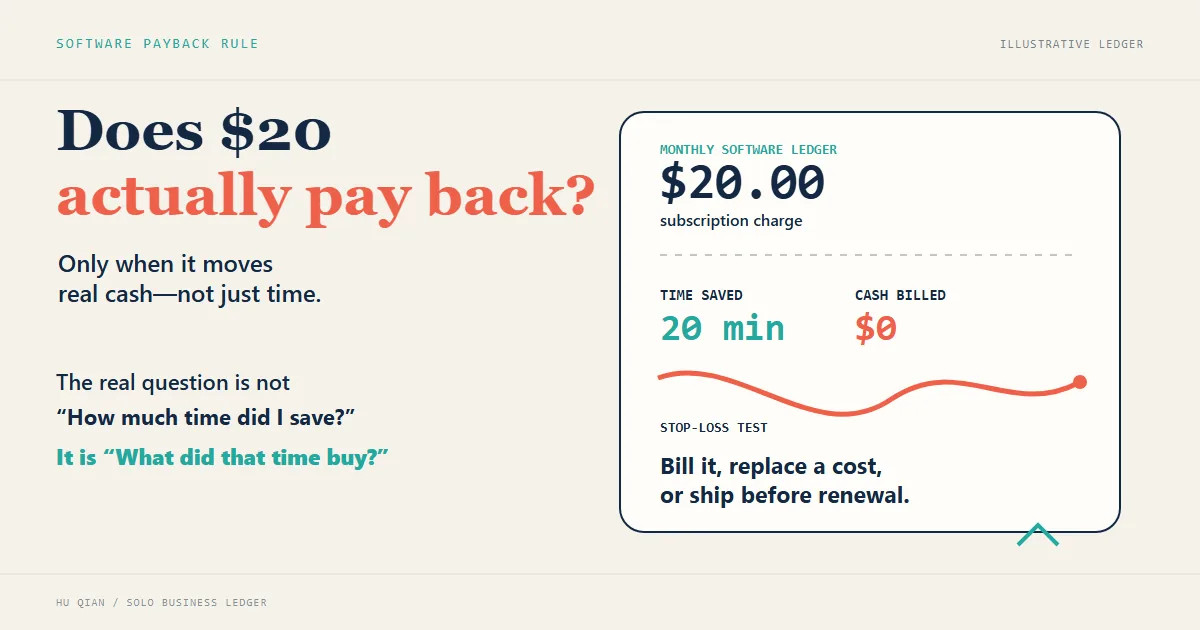
A $20/month tool pays for itself only when it bills a client, replaces a higher cash expense, or ships a revenue asset before renewal. Saving 20 minutes is not ROI if those minutes become scrolling. The test is simple: what did the time buy?
The hourly-rate ROI trap
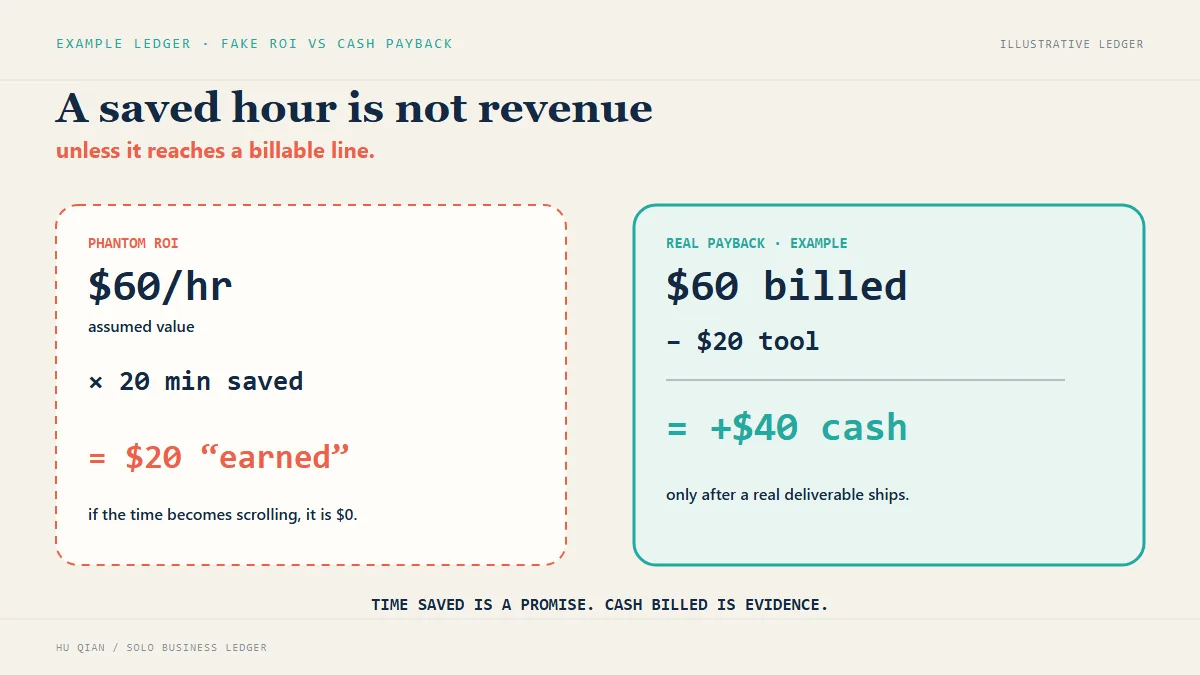
Software pages love this equation: $60/hour × 20 minutes saved = $20 earned. I do not accept it. Unbilled time is worth $0 until it reaches a paid deliverable.
Use three payback buckets:
- Billable throughput: the saved time lets you finish another paid deliverable.
- Hard-cost replacement: a $20 tool replaces a $50–$150 contractor task.
- Revenue asset shipping: the tool gets a paid page, product, or offer live before renewal.
If a tool fits none of these buckets, it is a hobby expense.
Cursor Pro versus Claude Code API
Cursor Pro costs $20/month. A typical Claude Code agent task using about 80,000 input tokens and 15,000 output tokens costs roughly $0.47 on Sonnet 4.6 or $0.78 on Opus 4.7, using the ledger assumptions for this article.
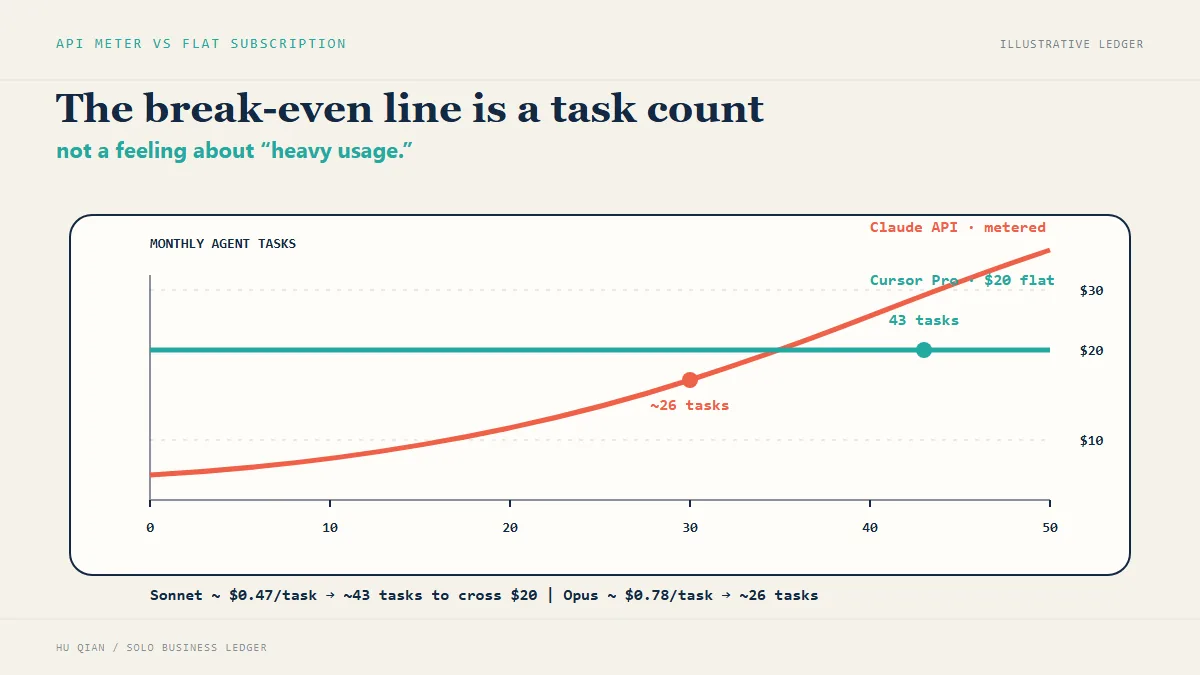
That puts the rough crossover at 43 Sonnet tasks or 26 Opus tasks per month against a $20 subscription. If you code only on occasional weekends, metered API usage is cheaper. If you ship repository-wide work every day, the flat subscription buys predictable spend.
My stop-loss rule is harsher: if one API session burns $2 without producing a clean, verifiable diff, clear or compact it. A robot repeating the same failed test is not productivity.
Runway credits have a reroll tax
Runway Standard lists 625 credits/month at $15 monthly or $12/month billed annually. Pro lists 2,250 credits/month at $35 monthly or $28/month billed annually.
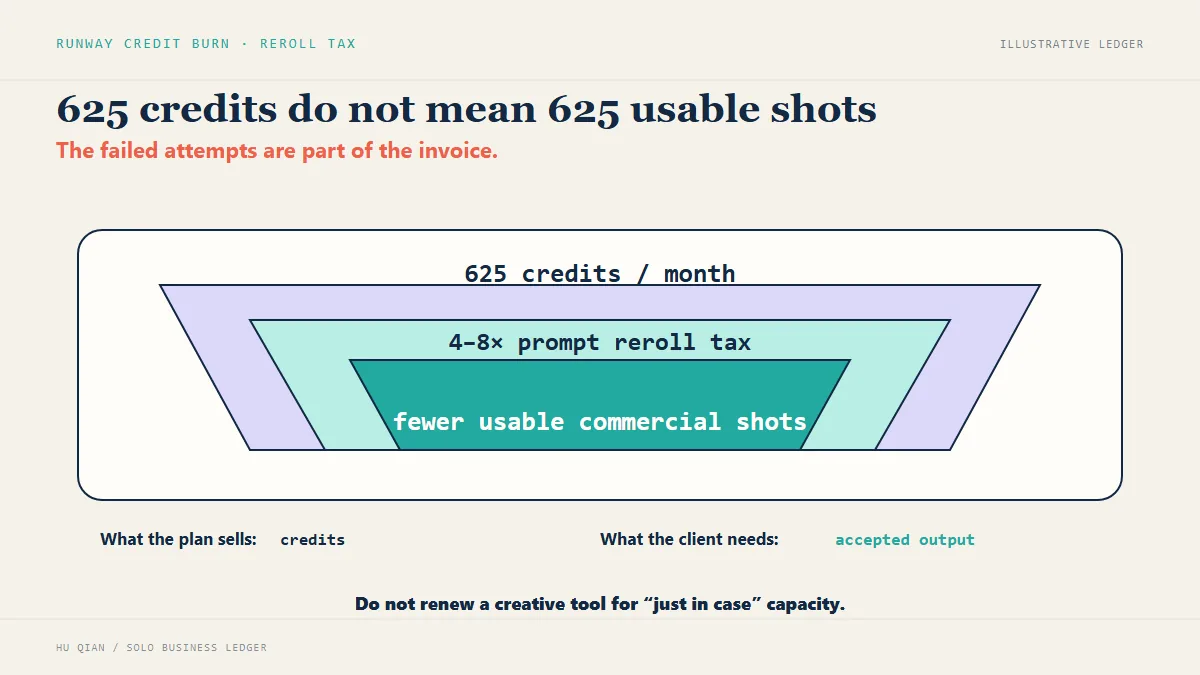
The plan sells credits. A client needs an accepted output. Four to eight rerolls for one usable clip can turn a large-looking allowance into a small batch of deliverables.
If the month has no paid video job, do not keep the subscription for imaginary capacity. Re-subscribe when a specific invoice justifies it.
From $201.99 to a $30 survivor stack
My default solo stack reached $201.99/month, or $2,423.88/year. The audited survivor stack kept Cursor Pro ($20) and GitHub Copilot Pro ($10): $30/month and $360/year.
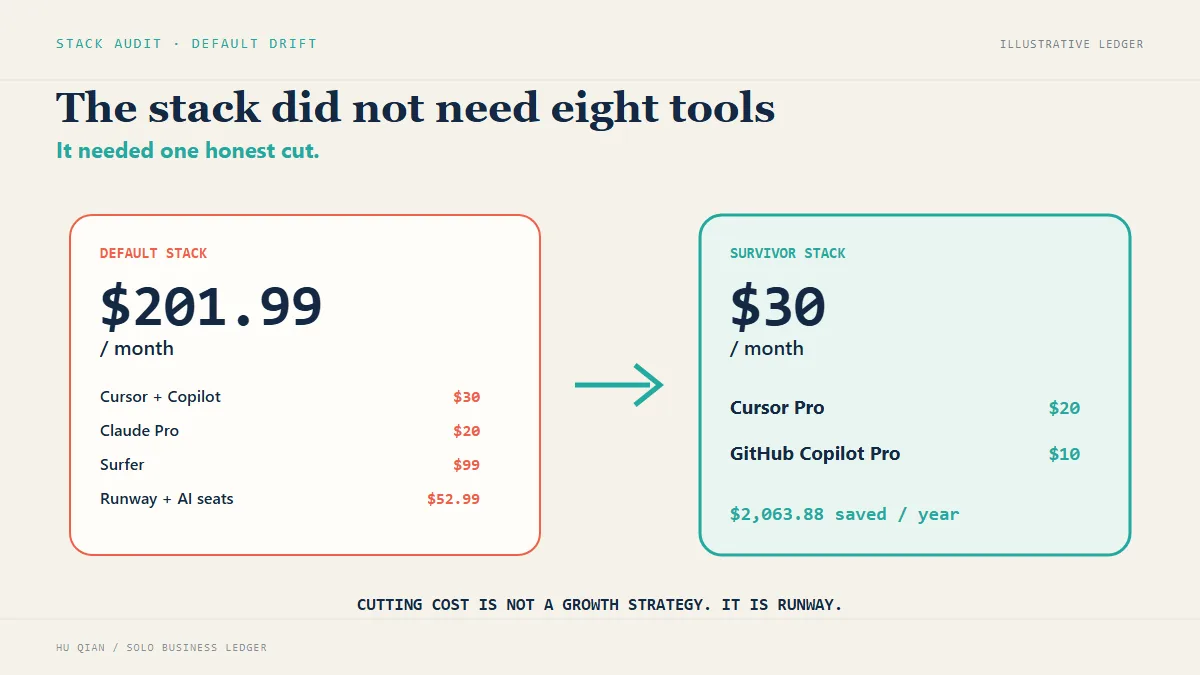
That is a reduction of $171.99/month and $2,063.88/year. The point is not austerity. It is runway. Do not buy team seats or industrial volume when the business is still one person and the demand is unproven.
A $99/month SEO suite is also premature when the site has only impressions and no repeatable clicks. More software cannot repair a missing acquisition loop.
The three-gate renewal test
Run every subscription through these gates before the next charge:
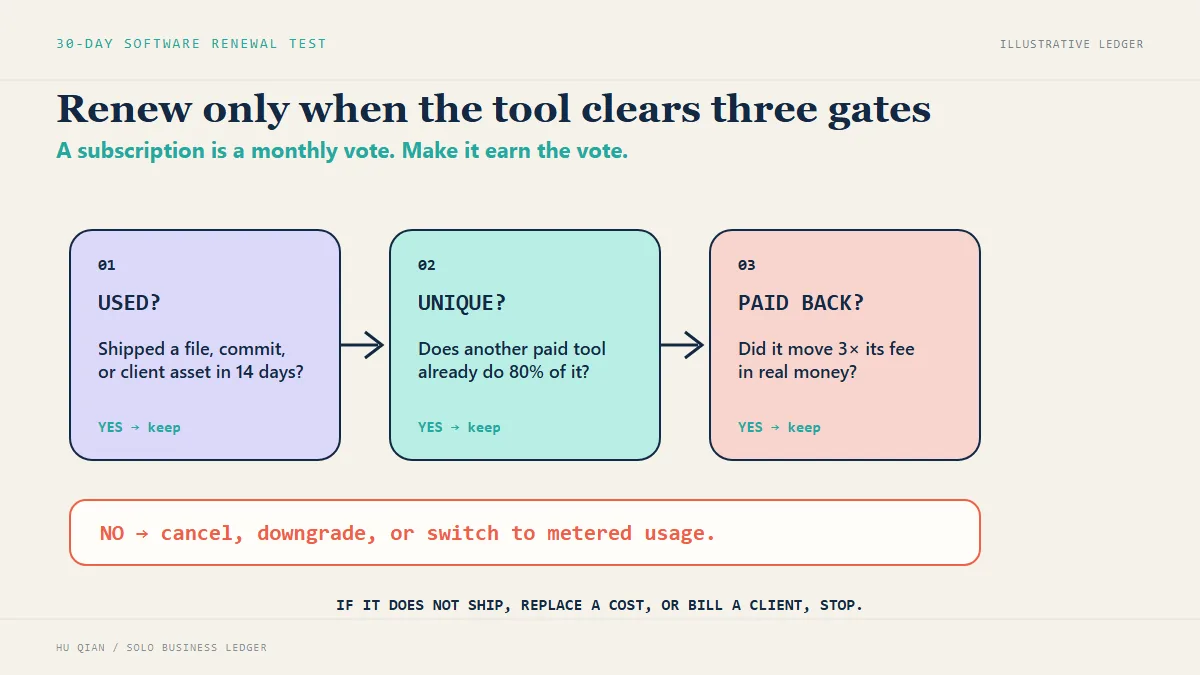
Gate 1: Used?
Did it help ship a file, commit, or client asset in the last 14 days? If not, cancel or downgrade.
Gate 2: Unique?
Does another paid tool already do 80% of the job? If yes, remove the overlapping seat.
Gate 3: Paid back?
Did it bill, replace a cost, or ship value worth at least 3× its monthly fee in the last 30 days? If not, switch to free or metered usage.
Software is leverage only when it moves a paid deliverable. If it renews without doing that, you are not the customer anymore. You are the recurring revenue.